Higher Education Advancement Migration from Salesforce to ServiceNow: A VP of Advancement's Operational Playbook

TLDRHigher education advancement migration from Salesforce to ServiceNow is the most operationally consequential platform decision an R1 advancement team will face this decade. The institutions that adopted Salesforce Education Cloud and Marketing Cloud somewhere between 2018 and 2023 built years of donor data integrity, gift processing workflow, prospect moves management, and campaign automation on the platform. The ServiceNow + Tenon stack is now a credible alternative for that workload, with Tenon delivering marketing automation natively on the ServiceNow AI Platform. This piece walks through what lives in a typical advancement Salesforce instance, what migrates well and what is harder, how the four-phase migration sequence executes for advancement specifically, the operational risk profile, and the questions a VP of Advancement should bring into the CIO evaluation conversation.

If you lead advancement at an R1 institution and your team built the annual giving program on Salesforce Marketing Cloud and the donor database on Salesforce Education Cloud over the last decade, the higher education advancement migration from Salesforce to ServiceNow conversation is not abstract for you.
The investment is real. Advancement teams that committed to Salesforce in the 2018-2023 window built donor data integrity that took years to clean up, designed Marketing Cloud journeys for annual giving and stewardship that the operation depends on, customized moves management workflows the major gift team trusts, and integrated prospect research feeds that the development officers count on.
None of that disappears overnight in a migration evaluation. None of it should.
To be precise about the destination: advancement workloads do not migrate to ServiceNow ITSM. They migrate to the ServiceNow CRM platform with Tenon as the marketing automation layer. The reason this is attractive is that many R1 institutions already run ServiceNow for ITSM or CSM, so the platform investment, the operational expertise, and the institutional governance posture are already in place. The advancement migration extends a platform the institution already owns into the CRM and marketing automation workloads that currently run on Salesforce.
Our piece on the Salesforce to ServiceNow migration evaluation walks through why R1 institutions are running this evaluation in the 2026-2028 renewal window: pricing trajectory, AI governance fragmentation, data fragmentation, renewal cycle convergence. Advancement leadership is the most politically consequential conversation in that evaluation, and the answer to the Marketing Cloud objection is Tenon, a marketing automation platform built natively on the ServiceNow AI Platform.
What follows is honest treatment of what migrates, what is harder, and how a VP of Advancement should think about the operational reality. The four-product delivery model applied to advancement specifically: Bettera as the higher-ed-exclusive implementation partner, ServiceNow as the destination CRM platform, Tenon as the marketing automation layer, Databricks as the data backbone.
Why advancement is the most consequential workload in the migration evaluation
Three structural reasons advancement deserves more careful sequencing than any other Salesforce workload an R1 institution might migrate.
First, advancement is typically the largest Salesforce investment at an R1 institution. Per-user licenses, Marketing Cloud capacity, Sales Cloud for the development officers, Salesforce Maps for moves management, and the integration layer to prospect research feeds add up. The advancement team often represents the largest seat count on the institution's Salesforce contract.
Second, the data is irreplaceable. Gift history goes back decades. Constituent profiles include relationship maps, giving capacity assessments, communication preferences, and accumulated stewardship context that took development officers years to build. The migration must preserve this asset with full fidelity.
Third, the operational continuity stakes are high. Annual giving campaigns generate institutional revenue. Major gift moves management cannot lapse. Stewardship cycles drive donor retention. Any migration that interrupts these operations costs the institution measurable money in the same fiscal year.
These three factors mean the advancement conversation cannot be handled with the same operational tempo as an IT-facing ServiceNow project such as an ITSM modernization.
Advancement leadership rightly asks harder questions and requires more conservative migration sequencing. What follows treats those questions as the primary subject, not as objections to be managed.
What lives in advancement Salesforce at an R1 institution
The typical advancement Salesforce footprint. This is the workload that migrates.
The constituent and donor record system. Built on Salesforce Education Cloud (formerly HEDA), this is the institutional system of record for donor identity, contact information, employment, education, family relationships, giving history, capacity ratings, and communication preferences. The accumulated data integrity is the most valuable asset in the advancement technology stack.
The gift processing workflow. Gift entry, soft credit attribution, receipt generation, acknowledgment routing to the appropriate development officer, and integration with the institution's general ledger.
The moves management framework. Major gift cultivation tracking, prospect assignment to development officers, contact reports, proposal tracking, and pipeline reporting for advancement leadership.
The Marketing Cloud journey portfolio. Annual giving solicitation series, capital campaign communications, stewardship cycles for major donors, event invitation and reminder flows, lapsed-donor reactivation campaigns, planned giving prospect nurture, and parent-fund communications. This is the workload that VP Advancement asks about first in any migration conversation.
The prospect research integration layer. Feeds from WealthEngine, iWave, DonorSearch, or Reeher that populate capacity ratings and wealth indicators on constituent records.
The event and volunteer management module. Reunion management, advisory board engagement, alumni event RSVP flows, regional chapter operations, volunteer assignment tracking.
This footprint took years to build. The migration evaluation respects every piece of it.
Tenon as the marketing automation layer for advancement
The single largest operational question in any advancement migration evaluation is what replaces Salesforce Marketing Cloud.
The answer is Tenon.
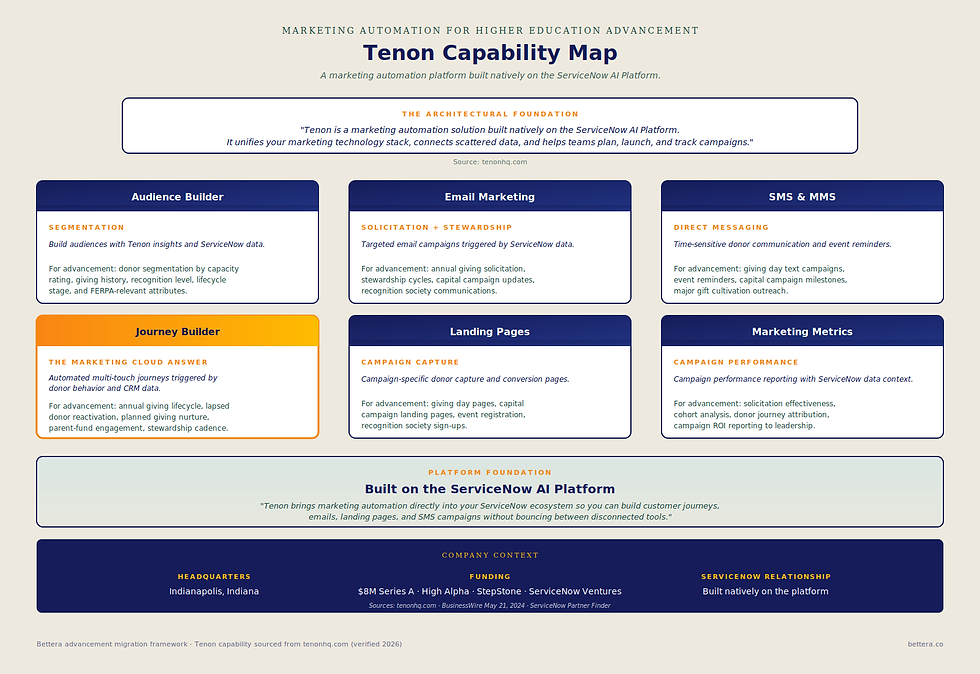
What Tenon is. Tenon is a marketing automation platform built natively on the ServiceNow AI Platform. The architecture is the key distinction. Marketing Cloud sits adjacent to Salesforce CRM and connects to it through integration. Tenon runs inside the ServiceNow platform itself, using the institution's ServiceNow CRM data as the source for audience targeting, journey orchestration, and campaign triggering once the constituent and donor records have migrated.
The Tenon capability footprint (sourced from tenonhq.com):
Audience Builder for segmentation across ServiceNow data
Email Marketing for solicitation, stewardship, and event communication
SMS and MMS for time-sensitive donor communication and event reminders
Journey Builder for automated multi-touch journeys triggered by donor behavior and CRM data
Landing Pages for campaign-specific donor capture
Marketing Metrics for campaign performance reporting
Why Tenon's architecture matters for advancement. The native-platform architecture produces three operational advantages relevant to advancement work.
First, real-time CRM data in marketing journeys. When a constituent's record is updated in ServiceNow (new gift recorded, capacity rating revised, communication preference changed, deceased flag set), Tenon sees that change immediately. Marketing Cloud integration latency that has caused awkward mistakes (solicitation sent to a deceased constituent, ask amount based on stale capacity data) is reduced by the unified data path.
Second, unified governance posture. FERPA-relevant donor communications (parent-fund campaigns that touch student educational records, alumni communications that reference enrollment history) inherit the institutional governance posture described in our piece on FERPA and AI compliance natively because Tenon runs on the same platform.
Third, cross-domain context. The Tenon journey for an alumni capital campaign can use signal from the same ServiceNow instance that holds the constituent's student service history, IT account status, and engagement with institutional communications across all channels.
The Bettera partnership with Tenon. Tenon does not publish a higher-ed-specific vertical. Tenon's published industries are Financial Services, Manufacturing, Retail, Technology, and Telecom. Bettera works directly with Tenon to develop the higher-ed-specific application patterns for annual giving, capital campaigns, stewardship cycles, and major gift cultivation communications. The deeper architectural argument for the Tenon partnership in higher education is in our Beyond the Help Desk white paper which Is located below.
What migrates well, what is harder
Honest assessment by workload type. Three categories.
Workloads that migrate well.
Constituent and donor records. Straightforward via Databricks-managed extraction and transformation. The data model on ServiceNow CRM is different from Salesforce HEDA, but the records map cleanly with appropriate transformation logic.
Gift processing workflow. ServiceNow's case management and workflow engine handles gift entry, routing, and acknowledgment as well as or better than Salesforce-native workflow. The general ledger integration is integration-dependent in both platforms.
Marketing Cloud journeys. The Tenon migration is the strongest argument in the entire evaluation. Tenon's Journey Builder, Audience Builder, Email Marketing, and SMS capabilities cover the operational footprint of Marketing Cloud journeys. The migration is non-trivial (journeys must be rebuilt, not lifted-and-shifted) but the destination capability is real.
Workloads that require deliberate work.
Moves management. ServiceNow's CRM platform handles the underlying workflow, but the specific moves management user interface that major gift officers depend on is Salesforce-native. The migration requires custom workflow development on ServiceNow, and the user experience for gift officers will differ. This is a real change for the advancement team and should be planned with development officer involvement, not handed to them after the fact.
Prospect research integration. Feed connectors from WealthEngine, iWave, DonorSearch, or Reeher are integration-dependent. Most have ServiceNow integration paths but the specific integration must be validated during Phase 1 inventory.
Workloads that may not move. Salesforce-specific Lightning component customizations, complex Salesforce Industries cloud implementations, or any workflow built on Pardot rather than Marketing Cloud may not have a clean Tenon equivalent.
These get identified in the Phase 1 inventory and the institution decides whether the rebuild cost is worth the consolidation benefit.
The four-phase higher education advancement migration from Salesforce to ServiceNow
The four-phase sequence applied to advancement specifically.
Phase 1: Advancement-specific inventory and dependency mapping. Catalog every workload above. Map the dependencies. Identify the Marketing Cloud journeys that will move first (typically stewardship and lifecycle campaigns where the political risk is lowest) and the journeys that move last (typically the annual giving primary solicitation series, where the operational and financial stakes are highest). This phase also produces the moves management redesign brief.
Phase 2: Parallel deployment, starting with a low-risk advancement workflow. ServiceNow + Tenon + Databricks deployed alongside the existing Salesforce + Marketing Cloud stack. The first workflow migrated is typically alumni-engagement-facing rather than donor-solicitation-facing. The Alumni Agent demo below shows what this looks like in operation: alumni records, transcript requests, and engagement workflow operating on the destination platform.
Bettera Agent in Action
Sarah is an alumna requesting her digital transcript. The workflow demonstrates alumni engagement on the destination platform: the operational pattern that advancement teams will recognize as the foundation for donor-facing operations.
The same platform that handles alumni transcript requests handles donor communications, stewardship journeys, and major gift cultivation. The architectural foundation is the same. The application to advancement-specific work is what Bettera delivers as part of the migration program.
Phase 3: Active journey and campaign transition. Marketing Cloud journeys transition to Tenon on a sequenced cadence. Stewardship first. Lifecycle communications second. Annual giving solicitation sequences validated against the prior year's Salesforce baseline before cutover. Moves management UI rolled out to development officers with structured training and an explicit rollback path during initial cutover weeks.
Phase 4: Sunset on natural renewal cycle. Salesforce contract not renewed. Any remaining Salesforce-specific advancement integrations either orchestrated via the patterns in our piece on orchestration-not-consolidation or retained deliberately.
The advancement-specific risk profile
The risks that VP Advancement should ask about explicitly.
Data fidelity risk. Decades of gift history must migrate without loss. Soft credit attribution. Acknowledgment status. Pledge balance. Recognition society membership. The risk is not "data does not migrate." Databricks handles the extraction well. The risk is subtle field-level differences that produce reporting inconsistencies discovered months after migration. Phase 1 inventory and Phase 2 parallel deployment exist specifically to catch this.
Active campaign continuity risk. Annual giving primary solicitation series cannot lapse during cutover. The Phase 3 sequencing rule is that any active campaign migrating to Tenon runs in parallel on both platforms during a defined validation window. Production traffic does not move to Tenon until the validation window completes.
Moves management adoption risk. Development officers depend on the specific Salesforce-native moves management UI. The ServiceNow equivalent will differ. This is a change management problem more than a technical problem. The Phase 1 brief includes a moves management redesign with development officer input, not a swap-in of the closest ServiceNow equivalent.
The institutions that handle these three risks well produce migrations that strengthen the advancement operation. The institutions that ignore them produce the migration failures cited in the cautionary case studies.
Frequently asked questions
What is the higher education advancement migration from Salesforce to ServiceNow?
Higher education advancement migration from Salesforce to ServiceNow is the strategic decision by an R1 institution to move its advancement workloads (donor records, gift history, Marketing Cloud journeys, moves management, prospect research integration, event and volunteer management) from Salesforce Education Cloud and Marketing Cloud onto the ServiceNow + Tenon stack with Databricks as the data backbone. The migration is structured as a multi-year program with four phases (inventory, parallel deployment, controlled workflow transition, Salesforce sunset on renewal) sequenced to protect active campaigns and donor data fidelity.
What replaces Salesforce Marketing Cloud for advancement on ServiceNow?
Tenon. Tenon is a marketing automation platform built natively on the ServiceNow AI Platform that delivers Audience Builder, Email Marketing, SMS and MMS, Journey Builder, Landing Pages, and Marketing Metrics. For advancement teams, Tenon handles annual giving solicitation sequences, stewardship cycles, capital campaign communications, event invitation and reminder flows, lapsed-donor reactivation, and planned giving prospect nurture. The architectural distinction from Marketing Cloud is that Tenon runs inside the ServiceNow platform itself, using the institution's existing ServiceNow data without an integration layer.
What happens to our donor data and gift history in a Salesforce to ServiceNow migration?
Donor records and gift history migrate through a Databricks-managed extraction, transformation, and load process designed to preserve full historical fidelity. Decades of gift history, soft credit attribution, pledge balances, acknowledgment status, and recognition society membership migrate to the ServiceNow CRM data model. The Phase 1 inventory produces the data quality baseline and the Phase 2 parallel deployment validates the migration before any production cutover. Field-level differences between the Salesforce HEDA model and the ServiceNow CRM model are reconciled during the data mapping work, not discovered after cutover.
How does Tenon handle annual giving and stewardship campaigns differently from Marketing Cloud?
The capability footprint is comparable for the operational work of building solicitation series, stewardship cycles, and donor lifecycle communications. The architectural difference is what changes operationally. Tenon uses real-time ServiceNow CRM data as the audience and trigger source, so a gift recorded in ServiceNow flows immediately into the journey logic without integration latency. A constituent flagged as deceased in ServiceNow is removed from active solicitations immediately. A capacity rating update propagates to ask-amount logic without a sync delay. The day-to-day journey building and campaign execution feels familiar to a Marketing Cloud user but with a tighter data path.
What is the operational risk to our annual giving program during migration?
The Phase 3 sequencing rule for active campaigns is parallel-validation before cutover. The annual giving primary solicitation series runs on both Salesforce Marketing Cloud and Tenon during a defined validation window. Production traffic does not move to Tenon until the validation window completes and the advancement team confirms results match the baseline. Stewardship and lifecycle communications migrate first because they have lower revenue stakes and tighter validation cycles. The annual giving primary solicitation series is one of the last journeys to cut over, not one of the first.
How long does an advancement migration take at an R1 institution?
The honest answer depends on the institution's Salesforce contract calendar, the size of the advancement Salesforce footprint, the data governance maturity, and the political readiness of the advancement leadership. The four-phase sequence is structured so that Phase 4 (Salesforce sunset) aligns to the natural renewal cycle of the displaced contract, which is what determines the overall program length. Phase 1 inventory and dependency mapping for advancement specifically is the leading work and produces the institution-specific sequencing plan, including the answer to whether to migrate at all.
Where this leaves the advancement team
The higher education advancement migration from Salesforce to ServiceNow conversation is real, and it is rightly the most carefully sequenced conversation in the broader migration evaluation. The investment in Salesforce was rational. The data the advancement team built is valuable. The Marketing Cloud journeys that the operation depends on do not disappear in this conversation. They migrate to Tenon, which delivers the same operational capability natively on the destination platform, with a tighter data path and unified governance.
If you are evaluating whether the migration framework applies to your advancement operation, that is the working session we facilitate at Bettera.
Contact us and we will walk through the advancement-specific Phase 1 inventory for your institution.
Bettera is the only ServiceNow consulting partner exclusively focused on higher education, and advancement migration is the most operationally consequential workload we lead R1 institutions through in 2026.
The Bettera-Tenon partnership and the deeper architectural argument for the four-product stack in higher education are covered in our Beyond the Help Desk white paper.
Public Sources Cited
Tenon, "Tenon - Marketing Automation Built on ServiceNow," tenonhq.com
BusinessWire, "Tenon Built on ServiceNow Announces $8M Series A Funding," May 21, 2024
TechTarget, "ServiceNow's Autonomous CRM takes aim at Salesforce," 2026
ServiceNow Newsroom, "ServiceNow expands AI Control Tower," Knowledge 2026