
Your CMDB Is a Roadmap Decision: What a ServiceNow CMDB Assessment in Higher Education Should Actually Tell You

TLDR: Institutions have paid between $40,000 and $60,000 on a time-and-materials basis for a ServiceNow CMDB assessment and received a conclusion they already had, which is that the CMDB needs work. That is not an accident of effort. Findings that are specific enough to act on are findings specific enough to scope, and scoping is where a traditional partner loses the follow-on engagement. A CMDB assessment is only useful when it does three things: score the data against evidence rather than opinion, read that score against the transformation roadmap the institution actually has, and sequence remediation by dependency rather than by which number looks worst. This piece covers the six dimensions worth scoring, why module readiness runs at the weakest dependency, why false green is the most expensive state a platform can be in, and what to ask any partner before they connect to your instance.
There is a consistent theme in the CMDB conversations we had across higher education this year. An institution commissions an assessment. Weeks pass. A deck arrives. The deck says the CMDB is incomplete, the relationships are thin, and governance needs attention. The platform owner reads it and recognizes every word, because that is what they said in the kickoff meeting.
The invoice for that recognition has run between $40,000 and $60,000 on a time-and-materials basis at institutions we have spoken with. What came back was directionally true and operationally useless.
It is worth being honest about why that happens, because it is not incompetence.
What Institutions Have Been Buying, and What Came Back
A findings document that names specific classes, specific fields, and specific record counts is a document an institution can hand to its own team and work without help. A findings document that says the CMDB is immature is a document that requires a follow-on engagement to interpret. The traditional consulting incentive runs toward the second one. Detail is expensive to produce and, for a partner selling the remediation, detail is expensive to give away.
So the assessment stays at altitude. Scores appear without the evidence that produced them. Recommendations appear without the sequence that makes them survivable. The institution ends up with a defensible-looking artifact that cannot be turned into a work list on Monday morning.
The value of a CMDB assessment is not the score. It is whether the score comes with the evidence and the sequence attached to it.
We built the free ServiceNow CMDB assessment as a direct answer to that pattern. It is free, it takes roughly ninety minutes of the institution’s time, and the institution keeps everything it produces. We are comfortable with that trade because the work that follows a real assessment is work worth being hired for on its merits.
Why a ServiceNow CMDB Assessment Is Now a Roadmap Question, Not an IT Data Question
For most of its life, the CMDB was treated as an IT hygiene concern. It mattered to the people who ran Discovery and mattered to almost no one else. That framing has stopped being accurate.
Every capability an institution is currently planning for reads from the configuration data. Change impact analysis reads relationships. Asset management reads attributes and lifecycle state. Service ownership reporting reads ownership fields. Now Assist grounded on CI data reads accuracy and staleness. An agentic use case that answers what a given outage actually affects reads relationships and accuracy together, and it does so without a human in the loop to notice that the answer is wrong.
That last point is the change. When a person read a thin CMDB, they compensated. They knew the record was stale, they asked a colleague, they made the routing call from memory. An agent does not compensate. It returns the answer the data supports, confidently, at scale.
This is also where the CMDB stops being an IT-only conversation. The 2026 EDUCAUSE Top 10 closes on decision-maker data skills and literacy, which is the institutional version of the same problem. Leaders are being asked to make decisions from institutional data. Configuration data is the layer underneath a large share of the operational decisions IT leadership makes, and most institutions have never measured whether it can carry that weight.
The Six Dimensions a Real CMDB Assessment Scores
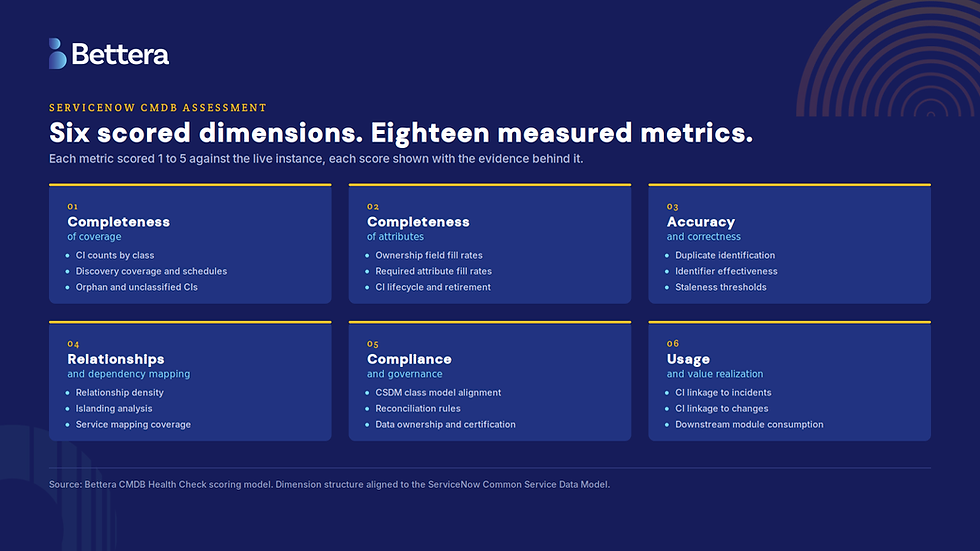
A CMDB assessment in higher education should produce an overall health score and a plain-language verdict on what that data can and cannot be trusted to support. Underneath that verdict, six dimensions carry the weight, with three measured metrics under each.
Completeness of coverage. CI counts by class, Discovery coverage and schedules, orphan and unclassified CIs. This answers whether the things that matter are represented at all.
Completeness of attributes. Ownership field fill rates, required attribute fill rates, CI lifecycle and retirement state. A record that exists but carries no owner cannot route anything.
Accuracy and correctness. Duplicate identification, identifier effectiveness, staleness thresholds. This answers whether the data can be trusted on the day it is read.
Relationships and dependency mapping. Relationship density, islanding analysis, service mapping coverage. This is what lets the CMDB explain what depends on what.
Compliance and governance. CSDM class model alignment, reconciliation rules, data ownership and certification. This answers whether anything is keeping the data healthy without a person intervening.
Usage and value realization. CI linkage to incidents, CI linkage to changes, downstream module consumption. A perfectly maintained CMDB that no process reads is an expensive archive.
The dimension structure aligns to the ServiceNow Common Service Data Model, which is the reference the platform itself is built against. Alignment to CSDM is scored rather than assumed, because a large share of higher education instances were stood up before CSDM guidance was widely adopted and have never been reconciled against it.
Each of the eighteen metrics carries its measured value, its score from one to five, and the evidence that produced it. That last part is the part most assessments omit. A score without its evidence is an opinion with a number attached.
Record-level findings, not summary findings
The technical output should be workable directly. That means specific classes, specific fields, and specific counts: discovery coverage and schedules, orphan and unclassified CIs, duplicate identification and identifier effectiveness, staleness thresholds, ownership and required attribute fill rates, reconciliation rules, relationship density and islanding, service mapping, CSDM alignment, CI lifecycle and retirement, and CI linkage to incidents and changes. The team should start with a work list rather than a discovery exercise.
Scoring the CMDB Against the Roadmap You Actually Have

This is the part that separates a technical review from a useful one. A generic CMDB assessment scores the data against best practice. A useful one scores the data against where the institution is trying to go.
The mechanic is simple. For any ServiceNow capability, readiness is not that capability’s own score. Readiness is the lowest score among the CMDB metrics that capability depends on. Asset management can be fully licensed and completely blocked because attribute completeness sits at a two. Event correlation can be provisioned and never run because service mapping coverage was never built.
Run that logic across the roadmap and three categories fall out.
Blocked. The capability is licensed or planned and the governing metric will not support it. The institution is paying for something it cannot turn on.
At risk. The capability is live and degrading. It works often enough that the failures get absorbed as noise.
False green. The capability is live, the dashboard is green, and the answers it returns are wrong. Everyone downstream believes them.
False green is the expensive one. A blocked module announces itself. A false green module quietly puts bad data into change approvals, ownership reporting, and now into the grounding context of AI features. It is the state most institutions are in and the state almost no dashboard reports.

Sequence Beats Score: How CMDB Remediation Should Be Ordered

The most common failure in CMDB remediation is not doing the wrong work. It is doing the right work in the wrong order.
An assessment that ranks findings by severity invites the team to attack the lowest score first. That usually means cleaning attributes and clearing duplicates. The team does the work, the score moves, and two quarters later the same fields are empty again, because nothing authoritative was writing to them in the first place. The cleanup was downstream of the actual defect.
Dependency-ordered remediation starts at the source. Establish what is authoritative for a given class. Tune Discovery and reconciliation so the authoritative source actually writes. Then correct attributes and relationships downstream, and instrument the metric so future decay is visible rather than discovered during the next audit.
A remediation roadmap should therefore carry more than a priority order. For each move it should name what the move is worth to the score, what capability it unlocks, why the data supports doing it now, and the projected overall score once the phase is complete. It should name the effort and the roles required, because resourcing conversations are where good roadmaps die. And it should be honest enough to contradict itself where the instance does not support the plan. A missing table or a refused read is a finding, not an error.
Projected health over time is the artifact executives most often lack. It lets the investment be justified before the work starts rather than defended after it.
From Audit to Instrument: Making CMDB Health Something You Watch
A one-time assessment tells you where you stand. It does not stop the drift that got you there.
Configuration data decays continuously. Departments stand up infrastructure, staff leave and ownership fields go stale, cloud accounts appear outside central governance, and research computing does what research computing does. This is the same dynamic we described in our piece on platform debt. The gap between the platform you bought and the one you are running does not open at go-live. It opens slowly, and it opens fastest in exactly the federated environments higher education runs.
The useful version of a CMDB assessment is therefore a standing instrument rather than a periodic audit. The same technical read runs against the instance on a recurring basis, the score is tracked as a trend rather than a snapshot, and remediation is advanced against the metrics that moved. Under a managed services relationship, that is how we run it: refreshed and worked on a weekly cadence, with trends carried at three, six, twelve, and twenty-four months.
The difference matters most for the conversation with leadership. A single score invites debate about methodology. A trend line invites a decision.
What to Ask Any Partner Running a CMDB Assessment in Higher Education
Whether the assessment is ours or someone else’s, these are the questions worth asking before anyone connects to your instance.
On the findings
Does every score come with the measured value and the evidence behind it, or only the rating?
Are findings reported at the record level, naming specific classes, fields, and counts?
Does the output distinguish what was measured from what was inferred, and is anything inferred clearly marked as needing validation with our teams?
Does it show which capabilities on our roadmap the current state cannot support, or only the current state?
On the roadmap
Is the sequence dependency-ordered, or ordered by which score is lowest?
Does each recommendation name the effort and the roles required?
Is there a projected score after each phase, so the investment can be justified in advance?
On security posture
Is the assessment read-only, and can the integration user be configured permanently read-only?
Does our own ServiceNow administrator create the OAuth client, so the institution holds the keys and can revoke access without going through the partner?
Is every read visible in our logs, showing the table and API accessed?
Are credentials encrypted rather than stored or shared, and is our data excluded from model training?
That last set is the one to press hardest on. Any partner asking for access to your configuration data should be able to answer all four without hedging, and your security office will ask regardless.

Frequently Asked Questions
What is a ServiceNow CMDB assessment?
It is a read-only evaluation of an institution’s configuration management database that produces a scored baseline, the business consequence of what it finds, and a prioritized remediation roadmap. A useful one scores against evidence from the live instance rather than against a questionnaire, and reads that score against the capabilities the institution is planning to deploy.
Why do most CMDB assessments tell institutions what they already knew?
Because specificity is commercially inconvenient for a partner selling the remediation work. Findings detailed enough to act on independently are findings the institution can scope and staff itself. Keeping the output general preserves the follow-on engagement. That is the incentive, and it explains the outcome better than effort or skill does.
How can a CMDB assessment be free when institutions have paid tens of thousands for one?
Most of the cost in a traditional assessment was manual data collection and manual analysis. That portion is now automated against the live instance, which removes the labor that the invoice was mostly paying for. What remains is judgment, and judgment is what the follow-on conversation is actually for.
Is a read-only integration safe for our instance?
It should be, and the controls are worth verifying rather than assuming. Your own administrator creates the OAuth client, so the institution holds the credential and can revoke it at any time. The client can be configured permanently read-only. Every read appears in your logs with the table and API accessed. Your security office will want to review the permissions, and that review is a normal and reasonable step.
Our CMDB was built by someone who has since left. Is an assessment still worth running?
That is one of the strongest cases for running one. When institutional knowledge left with the person who built it, the assessment is how the current team recovers a factual picture without reverse-engineering years of undocumented decisions. The output becomes the documentation that was never written.
Should we remediate the CMDB before deploying AI capabilities?
Not globally, and not as a blanket rule. Sequence by use case instead. Some capabilities depend on CMDB metrics that are already healthy enough to proceed. Others depend on metrics that will produce confidently wrong answers at scale, and those need the foundation work first. A readiness map tells you which is which, which is a far more useful answer than a single global readiness score.


