Higher Education IT Budget Planning: Scenario Answers


TLDR: Higher education IT budget planning now includes a question that did not come up as often five years ago: what stops if this budget comes down fifteen percent. Most institutions answer it in a spreadsheet, at speed, in a meeting where the answer becomes a commitment. The spreadsheet version collapses on the second follow-up question, because it can show cost but cannot show what is mandated, what is committed, what depends on what, and what the deferral costs later. This piece covers the four data points scenario planning actually requires, why separating mandated from discretionary work is the whole exercise, why three scenarios beat one, and what to bring into the room with the CFO and the provost.
Where the Pressure Is Coming From
The financial picture underneath these conversations has shifted in a way that is easy to misread from national averages.
The 2025 State Higher Education Finance report from SHEEO found that public higher education appropriations reached a record level in dollar terms, and that per-student funding still declined about one percent because enrollment grew faster than funding. SHEEO reported this as the first per-student decrease since 2012, and noted that eight states and the District of Columbia funded less per student in 2025 than they did in 2019. The association also framed the years ahead as an environment of constrained state budgets.
Put that next to federal research funding uncertainty and the enrollment picture at individual institutions, and the effect on a CIO is direct. The technology budget is being examined by people who did not examine it closely before, and they are asking about it earlier in the cycle.
EDUCAUSE named the corresponding capability in its 2026 Top 10, listing the move from reactive to proactive as the use of data for scenario modeling and forecasting to strengthen institutional agility, alongside a separate issue on data analytics for operational and financial insight. Both describe an institution that can answer a question about its own future quickly. Most cannot, and the reason is upstream of analytics.
Why the Spreadsheet Answer Collapses
The spreadsheet is not wrong. It is incomplete in a specific and predictable way.
Someone builds a list of projects with cost estimates, sorts by cost, and marks the bottom of the list for elimination until the number works. That produces an answer in about two hours, and it survives until the first follow-up question.
Which of these can we actually stop. Some cannot. A contractual renewal, an accessibility remediation with a deadline attached, and a security obligation are not candidates regardless of what the sort order says.
What breaks if we stop that one. The spreadsheet has no dependency information, so an item that looks independent turns out to be the thing three other items were sequenced behind.
What does deferring it cost us. This is the question that ends the meeting badly, because the honest answer is usually that the cost goes up, and there is no way to show by how much.
Who agreed to this already. Work that was committed to a dean, a governance body, or a grant sponsor has a different status than work that was proposed. A cost-sorted list flattens that distinction entirely.
None of those questions are unreasonable. They are the questions a good CFO asks. The problem is that they require portfolio data rather than a cost list, and the two-hour spreadsheet was never going to carry them.
The Four Data Points Higher Education IT Budget Planning Requires
Scenario planning does not need a sophisticated model. It needs four attributes on every item in the portfolio, and most institutions have some fraction of them scattered across systems that do not talk.
Cost, including the part that is not the invoice. License and vendor cost is the easy half. The other half is internal effort, which is what actually gets freed when something stops. An item with a small contract and two named people attached to it may free more capacity than an item with a larger invoice.
Funding source. Restricted funds cannot be redirected to close a general fund gap. Grant-funded work, gift-funded work, auxiliary work, and student fee work all follow different rules, and a scenario that assumes a fungible pool will propose reductions the institution is not permitted to make.
Commitment status. Proposed, approved, committed, and in flight are four different states with four different costs to reverse. Stopping something in flight usually means writing off work already done, which needs to appear in the scenario rather than surfacing afterward.
Dependency. Not full critical path, just the honest answer to what else was sequenced behind this. In higher education the most common dependency is a named person rather than a technical predecessor, which means stopping a project does not always free the constraint everyone assumes it frees.
Separating Mandated From Discretionary Is the Whole Exercise
Before any scenario can be run, the portfolio has to be split in two.

Mandated work has an external forcing function. Accessibility remediation with a deadline. Security and privacy obligations. Accreditation and reporting requirements. Contractual renewals and the support that keeps a system running. That work is not a candidate for reduction, and pretending otherwise wastes the first half of every budget meeting.
Discretionary work is everything with institutional discretion over timing. New capability, platform expansion, modernization programs, AI pilots, unit-requested improvements. This is where a reduction actually lands, all of it.
The number that changes the conversation is the size of the mandated column. When a CIO can say that a specific share of the technology budget carries an external obligation, a fifteen percent reduction to the total stops being a fifteen percent reduction to the work and becomes a much larger percentage of the discretionary portfolio. That is the argument, and it only exists if the split has been made in advance.
Two cautions. Mandated is not a label to over-apply, because a mandated column covering most of the budget reads as defensive and invites someone else to make the cuts. And a mandated item still has a cost that can be questioned. The obligation is not negotiable, but the approach to meeting it sometimes is.
Bring Three Scenarios, Not One
The instinct is to prepare the answer to the number that was named. A better move is to walk in with three.

Each scenario names what holds, what stops, and what the deferral costs later. Three does several things one cannot.
It removes the appearance of negotiation. A single scenario built around a single number looks like a position. Three look like analysis, and the difference in how the room receives them is significant.
It makes the shape of the cost visible. The step between flat and a modest reduction is usually small and manageable. The step to a deep reduction is usually not linear, because that is where committed programs get reversed and previously deferred work compounds. Showing the nonlinearity is more persuasive than arguing about any single number.
It shifts the decision to where it belongs. IT is not the right body to decide whether the institution absorbs the risk of deferred remediation for another year. That is an institutional risk decision. Presenting three scenarios with the consequences named puts the choice in front of the people whose choice it actually is.
The third column matters most. What deferral costs later is the part institutions consistently leave out, and it is the reason the same reduction gets proposed three years running while the underlying obligation grows. Deferred platform work is the clearest example, and we covered how that debt accumulates in closing the gap between the platform you bought and the one you are running.
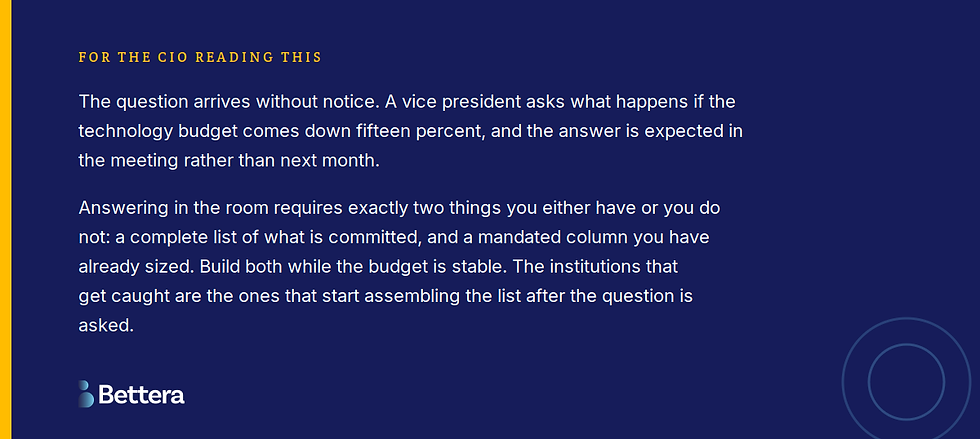
The short version: answering in the room requires a complete list of what is committed and a mandated column you have already sized. Both have to exist before the question is asked.
What To Bring Into the Room
Four things, and none of them is a slide about how hard IT is working.
The mandated number, stated as a share of the technology budget, with the obligation behind each item named. This is the foundation of everything else in the conversation.
The three scenarios, each showing what holds and what stops. Keep the scenario table to one page. A CFO will read one page and will not read eleven.
The deferral cost, quantified where it can be and described honestly where it cannot. "This grows by roughly this much per year of delay" is credible. "This will become a problem eventually" is not.
What the institution gets in the reduced scenarios. This is the one most CIOs skip, and it is a mistake. A reduction plan that describes only loss invites a larger reduction, because it reads as an institution that does not know what its own priorities are. Naming what still gets delivered, and tying it to the strategic pillars the board already knows, changes the register of the whole conversation.
Doing This Before the Question Arrives
Everything above depends on a portfolio that already exists. The list of commitments, the funding source on each one, the mandated flag, the dependency note. None of that can be assembled in the two weeks between the question and the meeting.
That is the real argument for portfolio work at an institution under financial pressure, and it inverts the usual objection. Portfolio management sounds like overhead when budgets are tight. In practice it is the only thing that makes a defensible answer possible when the money question arrives, and the money question is arriving earlier every cycle.
The institutions handling this well did not build the capability in response to a cut. They had it already, which is why they were able to answer in the room.
Frequently Asked Questions
What does higher education IT budget planning need that a project list does not have?
Four attributes on every item: cost including internal effort, funding source, commitment status, and dependency. A project list sorted by cost can show what things cost. It cannot show what is permitted to stop, what breaks if it does, or what the deferral costs later, which are the three questions that decide the outcome.
How much of a technology budget is usually mandated?
It varies widely by institution and there is no benchmark worth quoting. What matters is that the number is calculated from your own portfolio and defensible item by item. A share asserted without the obligations named behind it will be challenged, and correctly so.
Should IT propose the specific cuts or present the options?
Present the options with consequences named. Whether the institution accepts the risk of deferring a security or accessibility obligation is an institutional decision rather than a technology one. IT owns the accuracy of the scenarios. The choice among them belongs to the cabinet.
How do we handle work funded by grants or gifts in a reduction scenario?
Separate it out early and label it clearly. Restricted funds cannot be redirected to close a general fund gap, and a scenario that implies otherwise will be corrected in the room in a way that costs credibility. Showing restricted work as a distinct block also prevents the total technology spend from being read as the reducible number.
What if we do not have a complete portfolio yet?
Start with what is committed and mandated rather than trying to reach completeness. Those two categories answer most of the questions a reduction conversation raises, and they are a much smaller inventory than the full portfolio. The rest can be added over the following cycle.
The Honest Summary
The fifteen percent question is not really a budget question. It is a test of whether the institution can see its own commitments clearly enough to reason about them under pressure.
Size the mandated column. Put four attributes on every item in the portfolio. Bring three scenarios instead of one, and name what the deferral costs in each. Present the options rather than the decision. And build all of it while the budget is stable, because the version assembled after the question is asked will be wrong in exactly the places it is examined hardest.
Talk it through with us
If you are heading into a budget cycle without a defensible answer to the reduction question, we are happy to work through the mandated split, the four portfolio attributes, and what a one-page scenario view should look like for your institution.
Start a discovery conversation with Bettera, or read more about our advisory engagements.
About the author. David Holstein is the founder and CEO of Bettera, a ServiceNow consulting and implementation partner built exclusively for higher education. Bettera works with colleges and universities on ITSM, ITOM, CSM, SPM, and AI governance, with an AI-native delivery model.