ITOM and CMDB Health in Higher Education: Why the Foundation Most R1 Institutions Are Standing on Is Quietly Failing

TLDRITOM and CMDB health in higher education is the foundational layer that determines whether every other ServiceNow program at an R1 institution can deliver value. Most higher ed CMDBs are quietly in worse shape than the dashboards suggest. CI counts have stopped growing. Discovery coverage is below what the institution thinks it is. Service definitions list owners who left the institution years ago. Change management impact analysis is being done outside the CMDB in tribal-knowledge spreadsheets. This piece walks through the five-domain CMDB health assessment framework, the four diagnostic signs your CMDB is silently failing, what downstream ServiceNow programs break when the foundation is wrong, the four-phase remediation sequence, and why a ServiceNow ITOM Pro upgrade is the practical purchase moment that funds and accelerates the CMDB cleanup at most institutions.

If your institution has been running ServiceNow ITSM for three or more years and the last time anyone seriously audited the CMDB was during the original implementation, the foundation underneath your IT operations is probably in worse shape than the dashboards suggest.
The pattern is consistent across higher ed. CMDB gets built during the ServiceNow implementation. Discovery gets turned on. Service definitions get created. The CMDB looks right at go-live. Then time passes. Discovery keeps running but nobody validates the results. Service owners change roles or leave the institution. New infrastructure gets added without updating the CMDB. Application dependencies get documented in spreadsheets and Confluence pages rather than in the CMDB itself. The CMDB becomes the system of report rather than the system of record, and the operational consequences accumulate silently.
ITOM and CMDB health in higher education is the layer that determines whether every other ServiceNow program can deliver value. The AI governance framework described in our piece on Now Assist in higher education AI governance depends on Now Assist agents knowing which CIs they are operating on. The orchestration patterns described in our piece on orchestration-not-consolidation depend on accurate dependency mapping. The ITSM modernization path described in our piece on the ITSM modernization path depends on the CMDB being accurate enough to drive incident routing and change impact analysis.
Every strategic ServiceNow program at an R1 institution is built on top of the CMDB. When the CMDB is wrong, everything downstream is wrong.
What follows is the five-domain assessment framework Bettera uses with R1 institutions, the four diagnostic signs an IT operations leader can self-check against today, the downstream consequences when the foundation is degraded, the four-phase remediation sequence, and why ServiceNow ITOM Pro is the practical purchase vehicle that funds the cleanup work and delivers the discovery and service mapping tools that actually do the remediation.
Why CMDB health degrades silently
Most operational systems throw errors when something breaks. The CMDB does not. It just keeps reporting what it last knew, and what it last knew gets stale at a rate that depends on how active the institution's change cadence is and how disciplined the discovery and validation process is.
Four reasons CMDB health degrades silently at most higher ed institutions.
Discovery runs but nobody validates the results. Discovery jobs execute on schedule and populate CIs. Nobody checks whether the discovered CIs match the actual infrastructure. Whole classes of CIs get missed (unmanaged endpoints, shadow IT, departmental servers, lab equipment, embedded systems, research computing infrastructure). The CMDB looks like it is being populated. The population is incomplete.
Service definitions get created and never updated. A service gets defined during a project. The service owner is named. Then the service owner changes roles, or leaves the institution, or the service evolves to include different applications. The service definition does not change because nobody owns updating it. Six months later, the service in the CMDB is a fiction.
Application dependencies are documented in tribal knowledge. Change managers know which applications depend on which infrastructure components. They know it from experience, from outage post-mortems, from architectural conversations. They do not document it in the CMDB because documenting in the CMDB is slower than documenting in the spreadsheet they already maintain. The CMDB knows half of what the change managers know.
The CMDB is treated as a system of report. Reports run against it. Dashboards display it. Nobody changes it. The platform has become read-only by social convention, not by design.
Each of these is fixable. None of them is fixable accidentally.
The four signs your CMDB is silently failing
Bettera-original diagnostic framework. The reader self-assesses against four indicators in 15 minutes.
Sign 1: CI counts have not changed materially in 18+ months. The institution's infrastructure changes constantly. New servers, new applications, new SaaS subscriptions, new endpoints, decommissions, cloud migrations, research computing churn. A CMDB reflecting reality has CI counts that move in both directions, frequently. A CMDB with stagnant CI counts is a CMDB nobody is maintaining.
Sign 2: Discovery coverage is below 70% of known infrastructure. Discovery should be finding most of what the institution operates. The 70% threshold is a heuristic, not a hard line. Below 70%, the CMDB is missing meaningful chunks of the operational footprint. The Director of IT Operations can usually estimate this gut-feel by comparing the CMDB count to what they know is in the data center plus what they know is in the cloud.
Sign 3: Service definitions have stale owners. Spot-check ten service definitions in the CMDB. Count how many list owners who are no longer in the role attributed to them. If more than two of ten are stale, the service ownership layer of the CMDB is fictional.
Sign 4: Change management impact analysis is being done outside the CMDB. The most diagnostic sign of all. If change managers are using spreadsheets, Confluence pages, or tribal knowledge to figure out what a change will affect, the CMDB is not the system of record. It is the system of report. The actual system of record is wherever the change managers actually look.

If two or more of these four signs apply, the CMDB needs structured remediation, not incremental cleanup. The institutions running on a CMDB with two or more of these signs are operating with foundational risk that compounds across every downstream program.
What downstream programs break when the CMDB is wrong
The urgency-building section. Concrete consequences.
Change management impact analysis fails. Change managers approve a "low impact" change because the CMDB shows no dependencies. The change takes down a downstream service because the dependency existed but was not in the CMDB. The post-mortem identifies the missing dependency. Nobody updates the CMDB structurally. They add this one dependency. The pattern repeats.
Incident routing fails. A user reports an outage. The first-tier support team checks the CMDB to identify which team owns the affected service. The owner listed in the CMDB left the institution eight months ago. The ticket bounces. Time-to-resolution extends. The root cause is not the missing person. It is the CMDB governance model that allowed the ownership data to go stale.
AI Control Tower governance fails. Our piece on the ServiceNow AI Control Tower for higher education walks through the governance posture. The AI Control Tower governs Now Assist agents in the context of the services they operate against. When the CMDB is wrong, the AI Control Tower is governing against a wrong picture of what those agents do. The governance posture is incomplete by definition.
ITSM Pro tier value is unrealized. Predictive AIOps, performance analytics, advanced change risk, virtual agent: every premium ITSM feature depends on the underlying CMDB being accurate. Institutions paying for ITSM Pro on a degraded CMDB are paying for capabilities they cannot fully use. Our piece on ITSM Pro vs Standard establishes when the upgrade is worth it. The CMDB foundation is the prerequisite.
Vulnerability and audit response gaps. Security teams scope vulnerability remediation by service. If the service-to-CI mapping is wrong, the vulnerability remediation scope is wrong. Audit findings result.
Every future ServiceNow expansion is constrained. Any move into Tenon marketing automation, CSM/CRM expansion, agent surface deployment, or new AI workloads depends on the CMDB foundation. Building on a degraded foundation either underdelivers or fails outright.
The CMDB health assessment framework for higher education
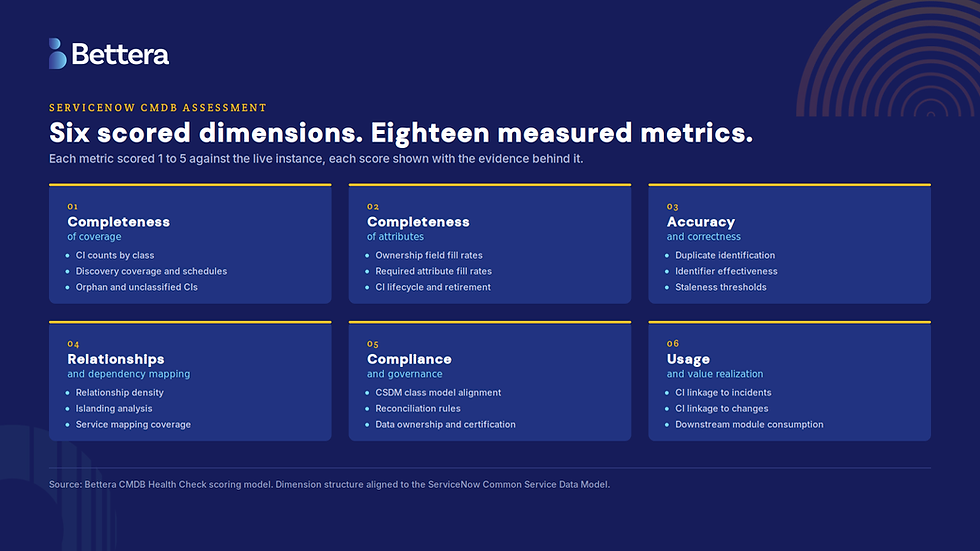
The framework Bettera uses to assess CMDB health at R1 institutions covers five domains, each scored on a 1-5 maturity scale with defined exit criteria for advancing to the next level. The framework is the leave-behind tool that an IT operations team can pin to their wall and use to baseline the institution's current state.
Domain 1: Data freshness and accuracy. How current and correct is the CI data itself? Maturity 1: most CIs are stale or unverified. Maturity 3: discovery is running, data quality issues are identified but not systematically remediated. Maturity 5: discovery is tuned, validation cadence is established, data quality KPIs are tracked, and stale data is remediated on a defined cadence.
Domain 2: Discovery coverage and quality. What percentage of the institution's actual infrastructure is in the CMDB and being kept current by discovery? Maturity 1: discovery is partial or running with stale credentials. Maturity 3: discovery covers core infrastructure but misses cloud, endpoints, or research computing. Maturity 5: discovery covers cloud + on-prem + endpoints + network + storage + research, with explicit coverage targets and reconciliation processes.
Domain 3: Service definition completeness. Are services defined in the CMDB, and is the definition complete (owner, dependencies, criticality tier, SLA tier, support hours)? Maturity 1: services partially defined or defined inconsistently. Maturity 3: services defined but ownership and criticality are inconsistent. Maturity 5: comprehensive service catalog with documented ownership, dependencies traced through to business outcome, and a defined update cadence.
Domain 4: Application and business service mapping. Is the dependency map from infrastructure CI to application to business service accurate enough to drive change impact analysis and incident routing? Maturity 1: dependency mapping is partial or undocumented. Maturity 3: application mapping exists for top-tier services but is not maintained automatically. Maturity 5: full application service mapping with verified dependencies and automated maintenance through Service Mapping discovery patterns.
Domain 5: CMDB governance. Is there a defined process for who owns CMDB integrity, how changes are made, who validates accuracy, and what the cadence of health audits is? Maturity 1: nobody owns it. Maturity 3: ownership is assigned but governance cadence is informal. Maturity 5: defined CMDB governance board, accountable owner, documented health audit cadence, KPIs tracked, regression mechanisms in place.
The institution running on Maturity 2 or below in any single domain has a foundational risk.
The institution running on Maturity 3 or above across all five domains can confidently build downstream programs on the foundation.
The Bettera Phase 1 engagement produces the institution-specific baseline across all five domains in 3-6 weeks.
The four-phase CMDB remediation sequence
What the remediation work actually looks like. Honest framing about internal lift, partner lift, what is hard, and what is straightforward.
Phase 1: Assessment and baseline. Run the five-domain framework. Establish current state maturity scores. Identify the top three remediation priorities. Document the existing tribal knowledge that lives outside the CMDB. Produce the institution-specific remediation roadmap with internal-lift and partner-lift estimates. This phase is typically 3-6 weeks and produces a defensible scope for the rest of the work.
Phase 2: Discovery tuning and CI cleanup. Tune discovery jobs. Resolve credential issues. Expand coverage to missing infrastructure classes (cloud, endpoints, network, research computing). Identify and remediate CI duplication and orphan records. Establish data quality KPIs and the dashboard that monitors them. This phase is technical work and is partner-lift heavy initially, with institutional teams taking over the ongoing operation.
Phase 3: Service definition and dependency mapping. Define or redefine the service catalog. Identify and assign service owners. Map applications to business services. Run Service Mapping discovery patterns for the highest-value services first. This phase is mostly institutional work because service ownership cannot be assigned by an external partner. Partner lift is structural support and tooling. Institutional lift is governance and ownership.
Phase 4: Governance model and ongoing health monitoring. Establish the CMDB governance board, the accountable owner, the audit cadence, and the KPI dashboard. Move the institution from "CMDB project" to "CMDB as ongoing capability." This phase is where most CMDB remediation efforts fail. Without ongoing governance, the CMDB regresses to where it started within 12-18 months. The sustained value of the cleanup work depends on this phase landing.
The sequence is designed so each phase produces value independently. An institution that funds Phase 1 and Phase 2 and pauses produces measurable improvement. An institution that funds all four phases produces a CMDB that stays healthy over time.
Why ServiceNow ITOM Pro is the practical purchase moment for CMDB cleanup
The honest case for the ITOM Pro upgrade. Not as an afterthought to the remediation work but as the vehicle that funds and accelerates it.
ITOM Pro is the ServiceNow product that brings Discovery and Service Mapping. These are the tools that actually do the CMDB cleanup work described in Phase 2 and Phase 3 above. Discovery finds and inventories the CIs. Service Mapping traces the application dependencies. Without these tools, the CMDB remediation is manual data entry. With them, the remediation is structured automation that produces results in weeks instead of quarters.
For institutions running ITSM-only today and facing the operational reality of a degraded CMDB, the ITOM Pro upgrade is the practical purchase decision that bundles the tools with the remediation work. The institution pays for ITOM Pro and gets a clean CMDB out of the same engagement. The CMDB cleanup work that would otherwise sit unfunded becomes the deployment work that comes naturally with the ITOM Pro license.
What ITOM Pro brings that core ITSM does not:
Discovery: automated CI population across on-prem infrastructure, cloud, endpoints, network, storage
Service Mapping: automated application dependency discovery and ongoing maintenance
Event Management: noise reduction and event-to-incident correlation
Cloud Discovery: AWS, Azure, GCP visibility for the cloud workloads most institutions now run
Certificate Management: prevents the kind of certificate-expiration outages that institutions hit annually
ITOM Visibility: dashboards and analytics across the operational footprint
The compounding effect for institutions also evaluating ITSM Pro. Institutions evaluating an ITSM Pro upgrade (predictive AIOps, performance analytics, advanced change risk, virtual agent) get a multiplier effect when ITOM Pro lands first. The ITSM Pro features depend on a healthy CMDB to deliver value. The ITOM Pro deployment produces that healthy CMDB. An institution that lands ITOM Pro first, then layers ITSM Pro on top, gets the compounding value of both upgrades reinforcing each other rather than ITSM Pro stalling because the underlying CMDB is wrong. Our piece on when higher ed should upgrade to ITSM Pro establishes the ITSM Pro decision in isolation. The ITOM Pro decision is the foundation that makes the ITSM Pro decision pay off.
For institutions already on ITSM Pro that have not yet unlocked the full value: the CMDB foundation is almost certainly the bottleneck. ITOM Pro is the path to unlocking the existing ITSM Pro investment.
What an IT operations leader should ask in any CMDB scoping conversation
Five forwardable questions for evaluating a CMDB remediation partner.
1. "What is your five-domain framework for assessing CMDB health, and how does it map to ServiceNow CMDB best practices?" Tests whether the partner has a defensible framework or is going to assess by intuition.
2. "Show me a Phase 1 assessment deliverable from a similar-size R1 institution." Tests whether the partner has done this work before and what the deliverable actually looks like.
3. "What is the internal-lift vs partner-lift estimate for each remediation phase, and how do you handle service ownership assignment given that the partner cannot assign internal owners?" Tests whether the partner understands that some of the work cannot be outsourced.
4. "What is the CMDB governance model you recommend, and how do you transition the institution from CMDB-as-project to CMDB-as-ongoing-capability?" Tests whether the partner is treating this as a project handoff or as an ongoing capability transfer. Most CMDB remediations fail at this transition.
5. "How does the ITOM Pro deployment integrate with the CMDB remediation work, and what does the combined engagement look like?" Tests whether the partner has thought about ITOM Pro as the funding vehicle and the technical accelerator, or is treating CMDB remediation and ITOM Pro as separate motions.
Frequently asked questions
What is ITOM and CMDB health in higher education?
ITOM and CMDB health in higher education is the operational state of the IT Operations Management product family and the Configuration Management Database at a higher education institution running ServiceNow. The CMDB is the system of record for the institution's infrastructure CIs, services, and dependencies. ITOM is the ServiceNow product family that includes Discovery, Service Mapping, Event Management, Cloud Discovery, Certificate Management, and ITOM Visibility. The CMDB and ITOM are foundational because every downstream ServiceNow program (incident routing, change management, AI Control Tower governance, ITSM Pro features) depends on the CMDB being accurate.
What are the most common signs a higher ed institution's CMDB is failing?
Four diagnostic signs apply consistently across higher education. CI counts have not changed materially in 18 or more months, indicating discovery is not actually populating new infrastructure. Discovery coverage is below 70 percent of known infrastructure, indicating significant blind spots. Service definitions list owners who have left the institution or changed roles, indicating ownership data is not being maintained. Change management impact analysis is being done outside the CMDB in spreadsheets or tribal knowledge, indicating the CMDB is not the actual system of record. Institutions with two or more of these signs need structured remediation, not incremental cleanup.
How long does CMDB remediation take at an R1 institution?
The honest answer depends on the current state maturity, the scope of infrastructure to remediate, the institution's data governance maturity, and the willingness of institutional teams to take ownership of service definitions. Phase 1 assessment runs 3-6 weeks. Phase 2 discovery tuning and CI cleanup runs in parallel with Phase 3 service definition and dependency mapping, with the combined duration depending on scope. Phase 4 governance establishment is ongoing. A defensible engagement scope produces measurable improvement in 90-120 days from kickoff, with full Maturity 4-5 across all five domains taking 9-18 months depending on institutional readiness.
Do we need to upgrade to ServiceNow ITOM Pro to fix our CMDB?
The honest technical answer is that ITOM Pro brings the Discovery and Service Mapping tools that actually do the CMDB remediation work efficiently. Institutions can remediate manually without ITOM Pro, but the cleanup is slower and harder to sustain. For most institutions, ITOM Pro is the practical purchase vehicle that bundles the remediation tooling with the license, and the CMDB cleanup work happens as part of the ITOM Pro deployment engagement. Institutions already running ITSM Pro that have not unlocked full value almost certainly need ITOM Pro to fix the underlying CMDB that ITSM Pro depends on.
Who should own the CMDB at a higher education institution?
The CMDB needs an accountable owner inside the institution. The right owner is typically the Director of IT Operations or the ServiceNow Platform Owner, with a defined governance board that includes service owners, change management leadership, and security leadership. The owner is responsible for the CMDB governance cadence, the data quality KPIs, the audit schedule, and the remediation of regression. External partners can do the technical work but cannot own the CMDB on behalf of the institution. The most common cause of CMDB regression 12-18 months after a successful remediation is that no internal owner was assigned.
What happens to AI Control Tower and Now Assist if the CMDB is wrong?
The AI Control Tower governs Now Assist agents in the context of the services they operate against. When the CMDB is wrong about which services exist, who owns them, and what they depend on, the AI Control Tower is governing against a wrong picture. Now Assist agents take action against CIs and services they may not fully understand. The governance posture is incomplete by definition. Institutions deploying Now Assist on a degraded CMDB are deploying AI on a foundation that cannot fully support the governance framework. The CMDB remediation is a prerequisite for trustworthy agent deployment, not an afterthought.
Where this leaves the IT operations team
ITOM and CMDB health in higher education is the foundational work that determines whether every other ServiceNow program at the institution can deliver value. The CMDB is not the most visible system in the IT operations footprint, but it is the system that almost everything else depends on. The institutions that invest in foundational CMDB health produce ServiceNow programs that compound in value over time. The institutions that defer the foundation work pay for capabilities that cannot fully deliver.
If you want to run the five-domain assessment on your own institution and would benefit from an outside read, that is the working session we facilitate at Bettera. Contact us and we will walk through the framework with your IT operations team, including how the assessment connects to a potential ITOM Pro deployment.
Bettera is the only ServiceNow consulting partner exclusively focused on higher education, and CMDB health remediation paired with ITOM Pro deployment is one of the most operationally consequential engagements we lead R1 institutions through in 2026.