ServiceNow Service Desk Consolidation in Higher Education

TLDR ServiceNow service desk consolidation in higher education is the move that turns ServiceNow from central IT's tool into the institution's IT platform. R1 universities typically run three to seven service desks across central IT, college IT, library IT, ResLife, athletics, the medical campus, and research computing. Most exist for legitimate reasons. The institutions that succeed do not eliminate federated desks. They consolidate the platform layer (instance, KB, CMDB, taxonomy, reporting) while preserving the service layer (team ownership, brand presence, local SOPs). This playbook covers the political sequence, the six-phase technical sequence, and the five artifacts that make the consolidation defensible to a federated owner group.
Multi-service-desk consolidation in higher education is the move that turns ServiceNow from central IT's tool into the institution's IT platform. R1 universities accumulate service desks the same way they accumulate everything else: by inheritance. Central IT, college IT, library IT, ResLife, athletics, the medical campus, research computing. Each desk made sense when it was created. None of them make sense in aggregate.
Faculty and staff who cross departments file the same kinds of tickets in three different systems and learn to call instead of ticketing. The ServiceNow consolidation is the move that fixes that. The work is operationally hard and politically harder.
The institutions that succeed do not eliminate federated desks. They consolidate the platform layer while preserving the service layer where it makes sense. This is the playbook for how that work runs in practice. Bettera is the only ServiceNow consulting partner exclusively focused on higher education, and the patterns below come from R1 consolidations we have run.
Why R1s end up with five service desks
R1 universities typically run three to seven service desks across central IT and federated departments. The federated desks exist for two kinds of reasons, and the first move that earns trust with federated desk owners is naming both kinds honestly.
The legitimate reasons. Proximity to the research environment (research computing groups serve faculty whose grant timelines do not match central IT's SLAs). Regulatory and accreditation context (medical campus IT operates under HIPAA, sometimes Joint Commission, and reports to a different chain). Mission distinction (ResLife runs ticketing on the same calendar as a hotel, not a help desk). Student-facing operational requirements (athletics IT runs equipment that is unique to its mission).
These desks should not be eliminated. They should be supported by a unified platform.
The accidental reasons. Org chart drift (a college decided to "own" IT after a budget cycle and never gave it back). Vendor sprawl (each desk picked its own ticketing tool when there was no central platform). Post-merger inheritance (a hospital system, a satellite campus, or a research institute that came in with its own desk). Identity attachment (a Director of IT Operations who built the current system and is still there).
The CIO who shows up assuming all federated desks are accidental loses the political conversation in the first meeting. The CIO who shows up acknowledging the legitimate reasons and asking which category each desk fits gets a working session.
This applies the same engagement pattern from our cluster on faculty governance and platform decisions to federated desk politics. The structural conditions are the same, just at a smaller scale.
What "consolidation" should and should not mean
The most common reason consolidation projects fail is that "consolidation" gets defined as "elimination." The federated desk owners hear "we are taking your tool and your team," dig in, and the project stalls.
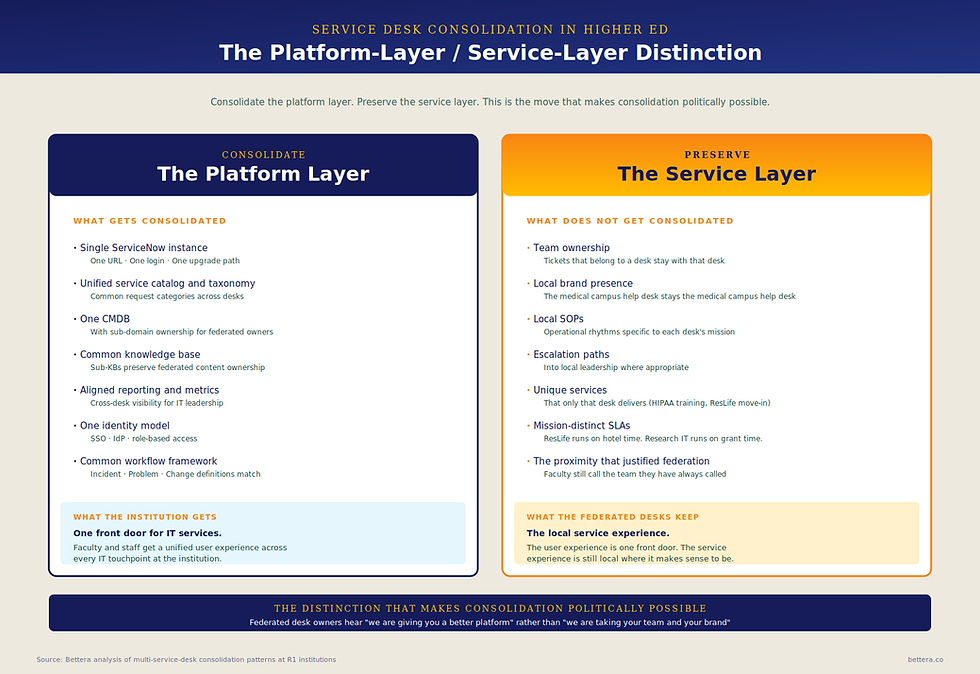
The institutions that succeed make a different distinction. We call it the platform-layer / service-layer distinction, and it is the conceptual move that makes consolidation politically possible.
The platform layer. What gets consolidated:
Single ServiceNow instance (one URL, one login, one upgrade path)
Unified service catalog and request taxonomy
One CMDB, with appropriate sub-domain ownership
Common knowledge base, with sub-KBs for federated content
Aligned reporting and metrics
One identity model (SSO, IdP, role-based access)
Common workflow framework (incident, problem, change definitions match)
The service layer. What does not get consolidated, by design:
Team ownership of tickets that belong to that team
Local brand presence (the medical campus help desk can still be the medical campus help desk to its users)
Local SOPs and operational rhythms
Escalation paths into local leadership
Unique services that only that desk delivers
This distinction is what makes consolidation politically possible. The college IT director who hears "we are not taking your team or your brand, we are giving you a better platform" responds completely differently from the one who hears "we are consolidating you under central IT."
The platform-layer / service-layer separation is also what produces the operational benefits without losing the proximity that justified the federated desks in the first place. Faculty in the college still call the same college IT team. The team uses ServiceNow now. Tickets that need central IT routing route automatically. Tickets that need to stay local stay local.
The user experience is one front door. The service experience is still local.
This is the same orchestration-not-consolidation framing our Pillar 1 piece on orchestration makes for the institution as a whole, applied to the IT layer specifically.
The political sequence
Three engagement moments with federated desk owners. Mirrors the same structure as Bettera's three-moment framework for faculty governance and platform decisions, applied to federated IT politics.
Moment 1: Frame-setting, before the technical work. Convene the federated desk owners. Bring the platform-layer / service-layer distinction. Be explicit about what is and is not being consolidated. Acknowledge the legitimate reasons each desk exists. Ask which category each desk fits.
The output of this conversation is not consensus on the consolidation. It is consensus on the terms of the conversation. Frame the program as a working session that the federated owners co-design rather than a decision they receive.
Moment 2: Pilot data, with the first volunteer desk. Pick the federated desk most likely to volunteer. Usually the one with the most pain in their current system, the one whose owner has been asking for help, or the one whose tooling contract is expiring.
Run a 90-to-120-day pilot. Produce real data. Bring the data to the next federated-owner meeting before any further consolidation moves. The data — better ticket routing, faster mean time to resolve, knowledge findability, agent satisfaction — is the artifact that earns the second desk.
Moment 3: Expansion governance, once the first pilot succeeds. Establish the federated desk owner group as a standing governance body. They review the consolidation roadmap quarterly. They decide which desk goes next. They approve taxonomy changes that affect their service catalogs. They sign off on the reporting framework.
The CIO is in the room, but the federated owners run the operational governance. This is the move that protects the consolidation from leadership turnover, budget cycles, and the political headwinds that kill multi-year platform programs.
The CIOs who run all three moments in sequence get a federated-owner group that builds the consolidation with them. The ones who skip Moment 1 or Moment 3 produce a technically successful consolidation that the federated owners resent for years afterward, which produces ongoing operational friction the success metrics never quite capture.
The technical sequence
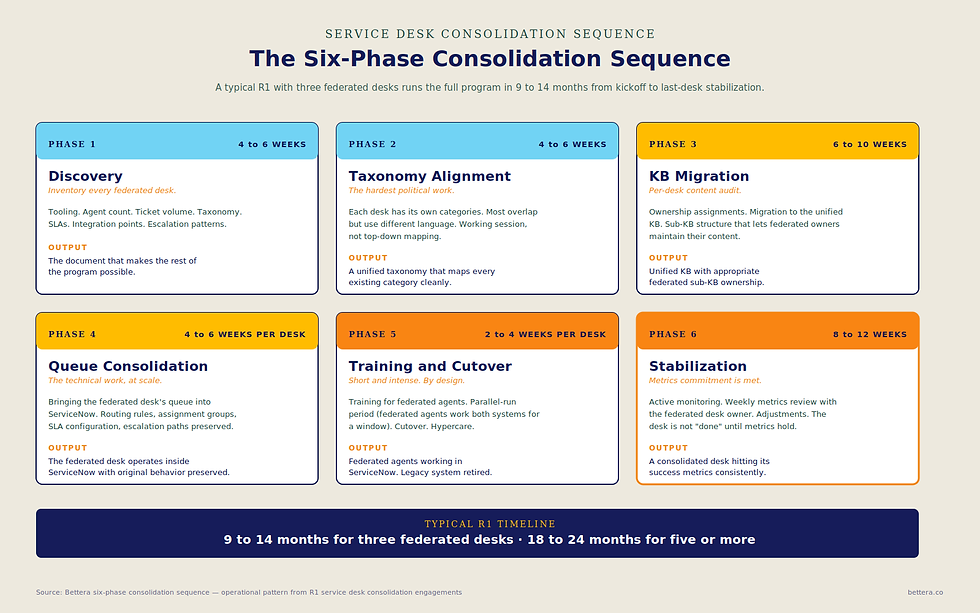
Six phases. Bettera's six-phase consolidation sequence is the operational pattern we have seen work at R1 institutions across the consolidation engagements we have run.
Phase 1: Discovery (4 to 6 weeks). Inventory every federated desk. Tooling, agent count, ticket volume, taxonomy, SLAs, integration points, escalation patterns. The discovery phase produces the document that makes the rest of the program possible.
Phase 2: Taxonomy alignment (4 to 6 weeks). The hardest political work. Each desk has its own categories, priorities, and request types. Most have meaningful overlaps but use different language. The alignment is a working session, not a top-down mapping. Federated desk owners participate. The output is a unified taxonomy that maps every federated desk's existing categories cleanly.
Phase 3: KB migration (6 to 10 weeks). Per-desk content audit. Ownership assignments. Migration to the unified KB. Sub-KB structure that lets federated owners maintain their content. Our forthcoming blog on unified knowledge management walks through this in detail.
Phase 4: Queue consolidation (4 to 6 weeks per desk). The technical work. Bringing the federated desk's queue into ServiceNow. Routing rules, assignment groups, SLA configuration, escalation paths preserved. This is the phase where the platform-layer work happens at scale.
Phase 5: Agent training and cutover (2 to 4 weeks per desk). Training for the federated agents on the new platform. Parallel-run period (federated agents work both systems for a window). Cutover. Hypercare. The cutover phase is short and intense — that is the design.
Phase 6: Stabilization and metrics commitment (8 to 12 weeks). Post-cutover, the federated desk operates in ServiceNow with active monitoring. Weekly metrics review with the federated desk owner. Adjustments. The desk is not "done" until the metrics commitment is being met consistently.
A typical R1 with three federated desks runs the full program in 9 to 14 months from kickoff to last-desk stabilization. Larger institutions with five or more federated desks plan for 18 to 24 months.
The five artifacts that make consolidation defensible
Five documents that convert the consolidation from a vendor-pitch decision into an institutional governance decision.
Decision rights map. Who decides what across the consolidated platform. Service catalog ownership. CMDB sub-domain ownership. KB sub-KB ownership. Reporting access. Workflow change approvals. The decision rights map is the artifact that resolves 80 percent of the political friction before it surfaces.
Service catalog crosswalk. Maps every federated desk's existing services to the unified service catalog. Documents which services are universal (password reset, account creation), which are local (medical campus HIPAA training requests), and which are aliased (the same service named differently across desks). The crosswalk is what makes Phase 2 taxonomy alignment defensible.
KB migration plan. Per-desk content audit. Migration priority. Ownership assignments. Sub-KB structure. The plan that makes Phase 3 navigable.
Communications plan. Faculty- and staff-facing. What changes, when, and what stays the same. The communications plan is the artifact that prevents "we used to call the library IT desk and now we call this number" complaints from becoming political problems.
Success metrics commitment. What the consolidated platform will deliver. Ticket routing accuracy. Mean time to resolve. Knowledge findability. Agent satisfaction. User satisfaction. The federated owners co-author this document. They commit to it. The CIO commits to it. The cabinet sees it.
These five documents together convert consolidation from a vendor-pitch decision into an institutional governance decision. That conversion is what gets the program funded and protected through the leadership cycles that kill most multi-year platform programs.
Frequently asked questions
How do you consolidate multiple service desks at a university?
Run the political sequence first, then the technical sequence. Start with the platform-layer / service-layer distinction so federated desk owners understand what is and is not being consolidated. Convene them as a governance body. Pick a volunteer desk for the first pilot. Run the six-phase technical sequence: discovery, taxonomy alignment, KB migration, queue consolidation, agent training and cutover, stabilization. A typical R1 with three federated desks runs the full program in 9 to 14 months.
How do we pick the first federated desk to consolidate?
Pick the volunteer. Usually the desk with the most pain in their current system, the desk whose owner has been asking for help, or the desk whose tooling contract is expiring. Volunteer desks succeed because the owner is invested. Drafted desks resist because the owner sees the consolidation as imposed. If no desk volunteers, the political work in Moment 1 is not done — return to that conversation before picking a desk.
What if a federated desk owner refuses to participate?
Acknowledge the refusal as a political signal, not a technical obstacle. Most refusals trace to one of three causes: the owner believes the consolidation will eliminate their team, the owner has a vendor relationship they are personally invested in, or the owner was not consulted before the program was announced. The first is solved by the platform-layer / service-layer distinction. The second is a longer conversation about institutional priorities. The third is the most common, and the fix is to restart Moment 1 with the dissenting owner specifically.
Do we need ITSM Pro to run consolidation?
No, but several Pro features make consolidation materially easier. Predictive Intelligence helps with the cross-desk taxonomy alignment in Phase 2. Performance Analytics produces the metrics commitment defensibly in Phase 6. Agent Workspace is what federated agents use to feel productive after cutover. Most institutions running serious consolidation programs are on Pro or upgrade as part of the consolidation. Our cluster on ITSM Pro vs. Standard covers the upgrade decision directly.
What does service desk consolidation cost?
Less than the institution thinks, in most cases. The ServiceNow license usually covers the platform layer cost; consolidating federated desks into the existing instance does not require new licensing in most contracts. The cost is in the change management work, the political work with federated desk owners, and the platform team capacity required across the six phases. Bettera offers a working session to scope this for your specific institution — contact us for the conversation.
How long does consolidation take?
Nine to fourteen months for a typical R1 with three federated desks. Larger institutions with five or more federated desks plan for 18 to 24 months. The timeline depends primarily on the number of federated desks, taxonomy complexity, and the institution's appetite for parallel-run periods during cutover. The political sequence runs in parallel with the technical sequence — it does not extend the timeline if it is sequenced correctly.
What if our federated desks use different ticketing systems entirely?
Standard pattern. The discovery phase inventories each system, the taxonomy alignment phase maps the categories, and the queue consolidation phase brings each system's data into ServiceNow. Common source systems: Cherwell, BMC Remedy, Ivanti, ServiceDesk Plus, Jira Service Management, Zendesk, Salesforce Service Cloud, and homegrown databases. Each has well-understood migration patterns. The data fidelity question (which historical tickets get migrated, which get archived) gets answered in Phase 1.
Where this leaves the institution
Multi-service-desk consolidation is one of the highest-leverage moves a higher ed CIO can make in the ServiceNow lifecycle. The work is unglamorous. It is documentary. It is iterative. It builds slowly.
The institutions that do it well end up with a platform their entire faculty and staff actually use, rather than five disconnected systems that produce duplicate work and missed tickets. The federated desks remain. Their work gets easier. The CIO has earned the political credit to expand ServiceNow into the next domain — usually CSM or HRSD, which our Pillar 6 piece on the ITSM modernization path covers as Moment 3.
For the broader case for ServiceNow as the institutional workflow platform, our Beyond the Help Desk white paper is the long-form argument.
If you want a working session on the consolidation framework with your federated desk owners, that is what we do.
Contact Bettera and we will walk through the playbook with your team.
Bettera is the only ServiceNow consulting partner exclusively focused on higher education.