ServiceNow Employee Workflows for Higher Education

TLDR: ServiceNow employee workflows in higher education are a mission protection play, not an HR efficiency project. Banner and Workday are systems of record that run payroll and hold the data. They were never built to run the employee experience, which is a different job that belongs to a system of engagement. ServiceNow sits on top of the record through Employee Center, HR Case Management, and Lifecycle Events, orchestrating onboarding, offboarding, and HR cases across every department the employee lifecycle touches, without replacing Banner. The higher education wrinkle is that one institution runs six employee lifecycles, faculty, adjuncts, graduate assistants, student workers, staff, and union, each needing its own eligibility-gated journey. The capabilities that carry this sit at the advanced HRSD tiers, and the AI layer only pays off once the knowledge base is grounded.

When I ask my mother about her job, her whole face changes. She has been a professor for most of her life. She will tell you that when she is in that classroom, she is in her zone. That is the word she uses. Her zone. Then I ask about everything else, the onboarding paperwork, the reimbursement she is still chasing, the access request that took three weeks, the benefits question nobody could answer, and the face changes again. All of that is one word too. A headache.
That contrast is the whole argument for employee workflows in higher education. The classroom is the mission. Teaching and research are the reason the institution exists. Everything wrapped around the classroom is friction. And that friction does not fall on interchangeable back office staff. It falls on the single most mission critical and hardest to replace people the institution has, and it pulls them out of the one place only they can stand.
So when we talk about ServiceNow employee workflows in higher education, we are not talking about an HR efficiency project. We are talking about protecting faculty and staff time, which is the scarcest asset a university owns. Every hour my mother spends fighting a headache is an hour stolen from her zone. Banner does not know that is happening. It was never designed to. The employee experience layer is what gives her the afternoon back.
Banner runs payroll. It was never the system of engagement.
Start with an honest distinction, because most of the confusion in this market comes from collapsing it. There is a system of record and there is a system of engagement, and they do different jobs.
Banner, Workday, and PeopleSoft are systems of record. They hold the authoritative employee data. They run payroll. They process the transaction. They were built to store and to compute, and they are good at it. What they were never built to do is intake and route the human work that wraps around an employee. Filing a request, getting it to the right person, tracking it to resolution, and keeping the employee informed the whole way. That is a different job. That is case work, not record keeping.
This is exactly where ServiceNow sits, and it is why the framing matters. ServiceNow does not replace Banner. It reads from it. Employee Center becomes the single front door where a faculty member, an adjunct, or a staff member goes to ask for anything, from any department. HR Case and Knowledge Management standardizes what happens next: the request is documented, routed, worked, and resolved through a consistent process with a record of every step. The connection back to Banner runs through IntegrationHub, so the authoritative data stays where it belongs and ServiceNow orchestrates the work on top of it.
We have written before about why this is the right pattern for higher education in general. If you want the full argument, read Orchestration, Not Consolidation, and for the specific integration mechanics with Banner, Banner Orchestration Patterns. The short version: replacement is expensive, slow, and risky, and the research on higher ed ERP outcomes does not favor it. Orchestration lets you keep what works and fix the experience.
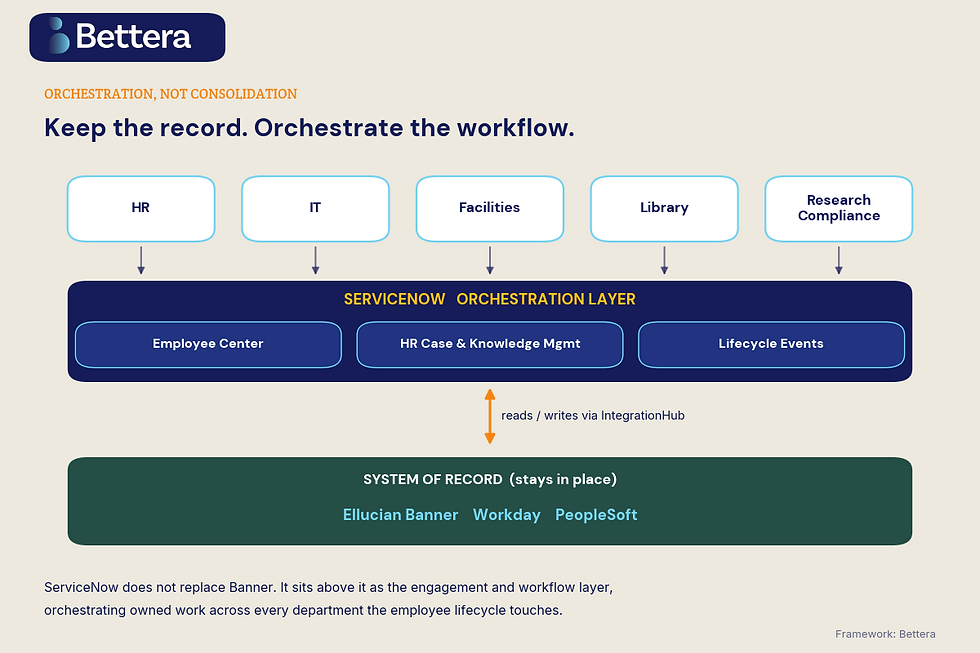
Record versus case. Transaction versus workflow. Banner and ServiceNow are not competing for the same job. Most vendors will not tell you that, because it is easier to sell a replacement.
Employee workflows in higher education are not the corporate playbook
Here is where domain matters, and where a generalist integrator gets it wrong. ServiceNow works with plenty of universities, but the out of box HRSD model, like most enterprise HR tooling, starts from a single corporate workforce. One kind of employee, one lifecycle, one set of approvals. Higher education adds complexity the default configuration does not assume, and it shows up on day one.
A single institution runs faculty, adjuncts, graduate assistants, student workers, staff, and in many cases union employees. That is not one employee lifecycle. It is six, and they barely resemble each other. Faculty have appointment cycles, tenure clocks, and sabbaticals. Adjuncts get contracted and recontracted on a rhythm that has nothing to do with a corporate hire date. Graduate assistants are employees and students at the same time. Student workers churn every semester. Union staff have approvals and protections written into a collective bargaining agreement. The corporate template has no idea what to do with any of this.
The technical answer in ServiceNow is Lifecycle Events. Lifecycle Events let you define distinct, triggered workflows that are gated by employee attributes drawn from the HR profile. A new faculty member triggers one journey. An adjunct triggers another. A graduate assistant triggers a third. You build them in Journey Designer with no code, and each one fires the right tasks, to the right owners, for that population only. So the real implementation work in higher education is not configuring one onboarding. It is modeling several eligibility gated journeys that share a spine but diverge where the populations diverge. That single design decision is the difference between a deployment that fits the institution and one that fights it.
One scoping note worth saying out loud, because it comes up in every real conversation. Lifecycle Events, onboarding and offboarding, HR performance analytics, and Manager Hub have historically lived in the Enterprise tier of HRSD, and Employee Center Pro is a separate subscription on top. ServiceNow has been actively renaming and repackaging its tiers, and its recent commercial model changes bundled AI across the lineup, so the exact tier names and inclusions are moving.
The point is not the current label.
The point is that the capabilities that make higher education employee workflows work are the advanced ones, and you should scope them deliberately with your account team rather than assuming the base package covers it.
What the headache actually costs
Reframe the cost the way my mother frames it. The institution is not losing a little HR efficiency. It is losing faculty and staff attention and satisfaction, and attention is the thing the institution is actually in the business of.
Think about the shape of the higher education year. HR and IT do not have a steady workload. They have August, when thousands of employees turn over, onboard, and change roles inside a few weeks, and the same spike again in the spring. A process that limps along in March collapses in August. When onboarding lives in email and tribal knowledge, the ninety day ramp quietly becomes a six month ramp, and the new hire spends their first semester unable to get into a building, a system, or a payroll cycle cleanly.
Sector bodies like EDUCAUSE have long put workforce capacity and administrative experience near the top of the list of strategic pressures in higher education, and anyone who has worked an August in a university already knows why.
This is the argument that moves a CIO and a provost, not just an HR director. Employee workflows are not a back office nicety. They are how you stop taxing your most valuable people with work that a platform should be doing for them.
What ServiceNow employee workflows actually orchestrate
Let me make it concrete, because this is where the abstract word orchestration earns its keep. Take onboarding a new faculty member. It touches HR, IT, facilities for office and lab space, the library, research compliance, parking, and the departmental admin who ends up chasing all of it. No single system owns that list, so today it happens over email and good intentions, and things fall through.
Now run it as one Lifecycle Event. The accepted offer fires the onboarding journey. That journey creates an HR case for contract and compliance tasks. It triggers an IT service catalog request for accounts, provisioning, and access. It triggers a workplace request for office and lab space, keys, and a badge. It triggers library and research system access. Each of those is a tracked task, with a named owner and an SLA, and all of them roll up to one journey record. Manager Hub gives the hiring chair a single view of every pending task instead of a folder full of forwarded emails.

The problem was never that the institution did not know how to onboard. The problem was that nobody owned the whole thing. The journey record is the owner.
This is what people mean, or should mean, when they say one platform. Not one giant system that swallows everything. One workflow layer where an HR journey can trigger an IT workflow and a facilities workflow and hold them together with ownership and accountability.
The record stays in Banner.
The work gets orchestrated in ServiceNow.
Offboarding is the same story, read backward, and it is a risk story
The mirror image reaches the CIO for a different reason. Offboarding in higher education is not a switch you flip. Emeritus faculty keep some access. Retirees linger in systems. Researchers hold data and grant access long after a formal end date. When deprovisioning is a manual checklist, access lingers, and lingering access is where the security and compliance exposure sits.
Run offboarding as a Lifecycle Event and every deprovisioning step becomes an owned task with an audit trail across IT, facilities, the library, and research systems. For the genuinely sensitive cases, Employee Relations adds tighter handling and privacy, and Vault for HR protects the underlying data. And for the population higher education always struggles to categorize, the emeritus faculty, the retirees, the seasonal and extended workforce, ServiceNow rebuilt Alumni Center to serve exactly those people. A professor who retires is not a clean termination. They are a status change with residual relationships and residual access. Connecting that reality to the right product is the difference between managing it and hoping.
The AI layer only works if you ground it
Higher education HR offices are chronically understaffed. A small central HR team serving thousands of employees cannot answer tier one questions by hand all day, and it should not have to. This is where the AI layer changes the math, and it is where our point of view is strongest.
In ServiceNow terms, three things do the work. Now Assist for HRSD summarizes cases, drafts resolution notes, and generates knowledge articles from resolved cases, so the team captures and reuses knowledge instead of re-answering the same question. Virtual Agent and Issue Auto Resolution deflect the routine questions inside Employee Center before they ever become a ticket. AI Agents take autonomous action across the lifecycle, initiating and completing steps rather than just answering.
Here is the nuance that separates a real practitioner from a demo. The AI is only as good as the knowledge it is grounded in, and higher education policy is fragmented across the faculty handbook, union agreements, and separate staff policy. Point an agent at a messy, contradictory knowledge base and it will confidently give wrong answers about someone's benefits or leave. So the real work is curating and grounding the knowledge base first. We wrote the playbook for that in Knowledge Management on ServiceNow, and it is the unglamorous step that determines whether the AI helps or hurts.
One more thing worth knowing. ServiceNow's recent commercial model changes bundled AI into the platform rather than selling it purely as a separate add on. For most institutions that means the AI capability arrived with the investment you already made. The question is no longer whether to buy it. It is whether you have the governance to deploy it responsibly. We lay that out in Now Assist in Higher Education.
Institutions that implement AI fast will innovate quickest. Institutions that pair that innovation with governance from the very beginning are the ones that scale it and earn trust. Employee workflows are a good place to prove you can do both.
Frequently asked questions
Does ServiceNow replace Banner or Workday?
No. Banner and Workday stay as your system of record and continue to run payroll and hold the authoritative employee data. ServiceNow sits on top as the engagement and workflow layer, orchestrating requests and cross departmental work and reading from the record through IntegrationHub. It is orchestration, not replacement.
What is the difference between HRSD and our ERP?
The ERP is a system of record built to store and process transactions. HR Service Delivery is a system of engagement built to intake, route, and resolve the human work around an employee. They do different jobs. Trying to make the ERP deliver employee experience is the mismatch most institutions are living with.
Can we run different onboarding for faculty, adjuncts, and student workers?
Yes, and you should. Lifecycle Events let you define separate, triggered journeys gated by employee attributes, built with no code in Journey Designer. Each population gets the right tasks and approvals for its own lifecycle rather than a single generic flow.
Do we need a specific HRSD license tier for this?
Generally the advanced capabilities matter here. Lifecycle Events, onboarding and offboarding, performance analytics, and Manager Hub have lived in the Enterprise tier, and Employee Center Pro is a separate subscription. ServiceNow is actively repackaging its tiers, so confirm current names and inclusions with your account team for your release before you scope.
Where does AI actually fit in employee workflows?
In three places. Deflecting tier one questions through Virtual Agent and Issue Auto Resolution, accelerating agents through Now Assist for HRSD, and automating steps through AI Agents. All three depend on a grounded, curated knowledge base, which is the work to do first.
What is the first employee workflow to orchestrate?
Onboarding, almost always. It is the most cross departmental, the most visibly broken, and the one where a single orchestrated journey produces an obvious win that builds momentum for the rest.
About the author. David Holstein is the founder and CEO of Bettera, the ServiceNow consulting partner built exclusively for higher education.
Bettera helps colleges and universities modernize ITSM, CSM, HRSD, and Now Assist with an AI native delivery model, using an orchestration approach that works with the systems institutions already run rather than replacing them.

Related reading: